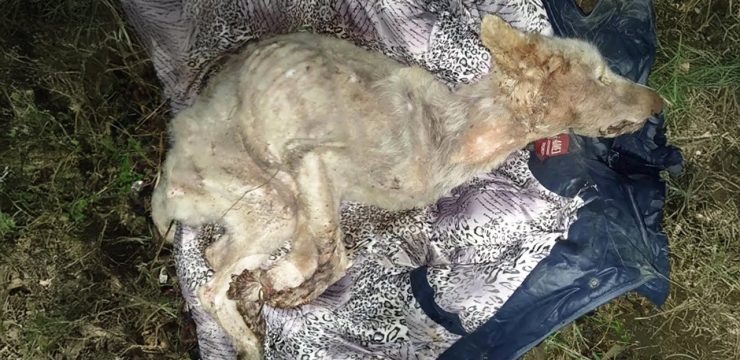
On a bitterly cold day, a small dog was spotted slowly making his way through the snow — not running, not trotting, but crawling. His hind legs dragged uselessly behind him as he pulled himself forward with only his front paws. His body was painfully thin, every rib visible beneath his matted fur. His eyes carried a kind of sorrow that went far deeper than hunger.
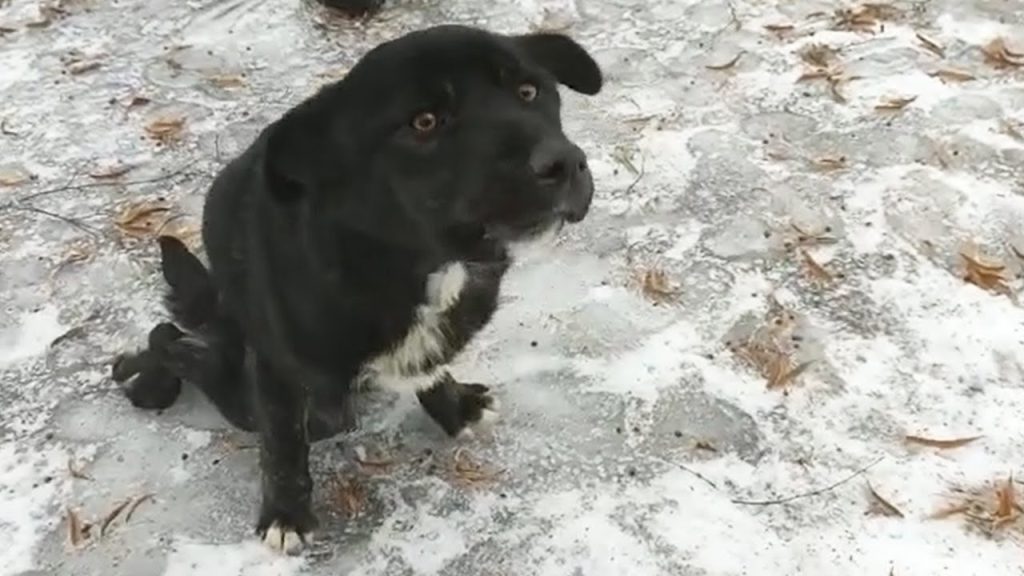
His name would soon become Oscar. But when he was first found, he was just a terrified, broken creature trying to survive one more hour in the freezing cold.
Oscar had been hiding in a damp, dark corner — the kind of place an animal retreats to when it no longer trusts the world around it. He had clearly been there for some time, too afraid to move, too afraid to be seen. But hunger is a powerful force, and eventually, it overcame even his deepest fears. He crept out slowly, cautiously, and began to beg for food in the only way he knew how — by simply being there, fragile and trembling, hoping someone would notice.
Someone did.
Rescuers brought Oscar in immediately, and a veterinarian examined him with great care. There was a small but significant relief in the initial assessment: Oscar still had some feeling in his hind legs. That tiny detail — that small flicker of sensation — would later mean everything.
But the X-rays told a devastating story.
Oscar’s jaw was broken. His spine had suffered severe fractures. These were not the kinds of injuries that happen by accident. The rescue team could only conclude that this gentle dog had endured deliberate, forceful harm — the kind inflicted by someone who chose cruelty over compassion. The thought was almost impossible to bear. Yet there was Oscar, still breathing, still present, still somehow holding on.
The medical team moved quickly. Oscar underwent intensive surgical procedures to repair his shattered spine and fractured jaw. The surgeries were long, complex, and carried enormous risk. When he finally came through and began to recover, something quietly wonderful happened — Oscar was hungry. Not just a little hungry, but ravenously, joyfully hungry. He ate canned food with such enthusiasm that the caregivers around him laughed and cried at the same time. It was the first sign that somewhere inside this battered little body, there was still a spirit that wanted to live.
But the road ahead was not easy. Due to the severe damage to his spinal cord, veterinarians were honest with the team: Oscar had only about a fifteen percent chance of ever walking again. Those were grim odds. For many, that number might have signaled the end of hope. But for the people who had already committed their hearts to this dog, it simply meant they had work to do.
Every single day, Oscar’s caregivers showed up for him. Physical therapy became a sacred routine — gentle exercises, careful movements, endless patience. And Oscar, to the amazement of everyone, showed up right back. He was cooperative, calm, and attentive. He looked at the people helping him with eyes full of quiet gratitude, as though he understood exactly what they were trying to do for him and was doing his best to meet them halfway.
Then came the moment no one dared to expect.
Oscar lifted his hindquarters on his own.
It was a small movement by most measures. But in that room, at that moment, it felt like a miracle. The team erupted in emotion. Everything they had poured into this dog — every hour of therapy, every whispered word of encouragement, every prayer — had just taken one small but magnificent step toward becoming real.
To further support his mobility and help him rebuild his strength, Oscar was fitted with a custom wheelchair designed specifically for dogs like him. Watching him move in it for the first time was something no one who witnessed it would ever forget. He adapted with a confidence and ease that seemed to reflect something deep in his character — an unwillingness to stay still, an instinct to keep moving forward no matter what.
And forward he has gone.
Since those early days of recovery, Oscar’s muscles have continued to grow stronger. He moves more freely. He plays. He rests without fear. And perhaps most beautifully of all, he loves — fully and without reservation — the people who chose to save him when the world had already let him down.
Oscar’s story is not just about the survival of one dog. It is about what becomes possible when someone decides that a life is worth fighting for, even when the odds say otherwise. It is about the extraordinary bond that can form between a human and an animal when both sides show up with open hearts.
There are dogs in this world who have been through things no living creature should ever endure. Oscar was one of them. And yet, given the chance to heal, given the gift of consistent love and care, he became living proof that resilience is not reserved for the strong — sometimes, it belongs most fully to those who have suffered the most deeply.
Oscar did not give up. And because of that, neither did anyone else.