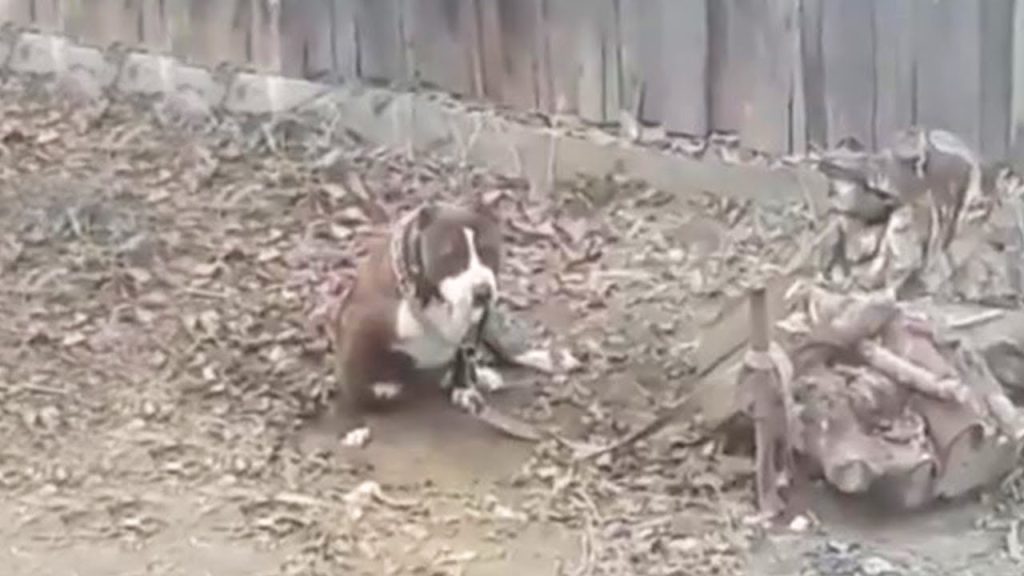
When rescuers first laid eyes on Atrey, they couldn’t hold back their tears. There he was — a dog chained to a post, unable to stand, dragging himself along the ground with only the strength of his front legs. His hind legs had wasted away to almost nothing, robbed of all function. He hadn’t been abandoned for a day or even a week. The neglect had gone on for so long that his body had already begun to give up on itself.
But Atrey hadn’t given up. Not even close.
The rescue team moved quickly, bringing him in for immediate medical evaluation. What the tests revealed was sobering: Atrey was suffering from a spinal compression tumor that had stolen the use of his back legs, and on top of that, he had been silently fighting heartworm — a serious parasitic infection that had taken hold in his lungs. For a dog who had been living chained and alone, with no medical care and no one to advocate for him, the odds felt overwhelming.
What no one expected was the spirit hiding beneath all that suffering.
The moment someone handed Atrey a toy, something remarkable happened. His eyes lit up. His tail began to wag. In spite of everything his body had endured, in spite of months of pain and isolation, this dog found pure joy in a simple plaything. It was the kind of moment that reminds you why rescue work, as heartbreaking as it can be, is also one of the most profoundly hopeful things a person can dedicate themselves to.
The medical team moved forward with surgery to remove the spinal tumor. Everyone held their breath — and then came the news they had all been praying for. The tumor was benign. Atrey had cleared the first and most dangerous hurdle. Now the real work could begin.
Rehabilitation started slowly, with great care and even greater patience. Atrey was fitted with a specialized wheelchair designed to support his body while giving him the freedom to move on his own terms. Watching him roll through a room for the first time, his front legs propelling him forward with surprising confidence, it was hard not to feel a surge of emotion. He didn’t sulk. He didn’t shy away. He simply adapted, the way dogs so often do — with a kind of uncomplicated courage that puts the rest of us to shame.
Physical therapists worked with him consistently, using large therapy balls to target his weakened glute muscles and help correct his posture. These weren’t passive sessions. Atrey was an active participant, working hard alongside the people who had chosen to fight for him. Every small improvement — a tiny shift in balance, a moment of greater stability — was celebrated like a victory, because that’s exactly what it was.
Nine months into his recovery journey, the team introduced hydrotherapy. The water provided a gentle environment where Atrey could work his back muscles without the full pressure of gravity bearing down on him. It was demanding work, and there were days when progress felt invisible. But the caretakers never wavered, and neither did Atrey.
After nearly a full year of intensive physical therapy across multiple care facilities, the team arrived at a moment of honest reflection. Atrey had come so far — he could stand on his own, and with effort, he could take a few steps. But the full return of his mobility was not going to happen. The damage had simply been too extensive, the window for complete recovery too narrow by the time he was found.
This could have felt like defeat. It didn’t.
Instead, the rescue team made a decision rooted in love rather than expectation. They chose to stop the exhausting therapy sessions and simply let Atrey live. Not push harder, not chase a goal that was out of reach — but live. Rest. Play. Be loved.
And that is exactly what he does now.
Atrey moves through his days with the quiet contentment of an animal who knows, in whatever way dogs understand these things, that he is safe. His wheelchair carries him where he wants to go. His people are there when he needs them. The chain that once held him is gone, replaced by warm hands and gentle voices and a soft place to sleep at night.
His story is not one of perfect healing. His legs did not fully recover. The road back was long and hard and ultimately incomplete in the way that most human — and animal — stories are. But Atrey did not need a perfect outcome to have a beautiful life. He needed someone to see him, to choose him, and to refuse to look away.
Someone did.
If Atrey’s journey moves you — and if you’ve read this far, it probably has — consider this a gentle reminder of how much difference one decision can make. The decision to stop, to help, to not pass by. Somewhere out there, another Atrey is waiting for exactly that moment.