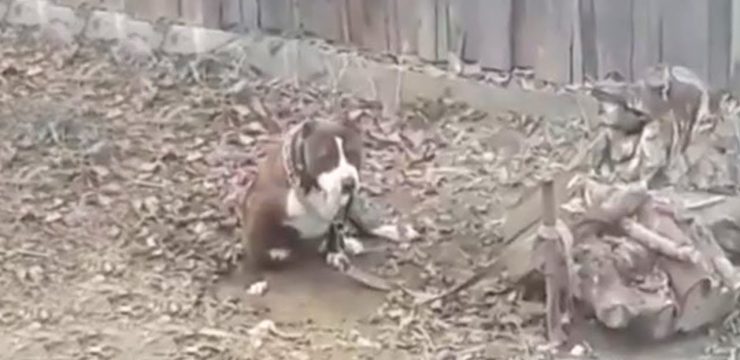
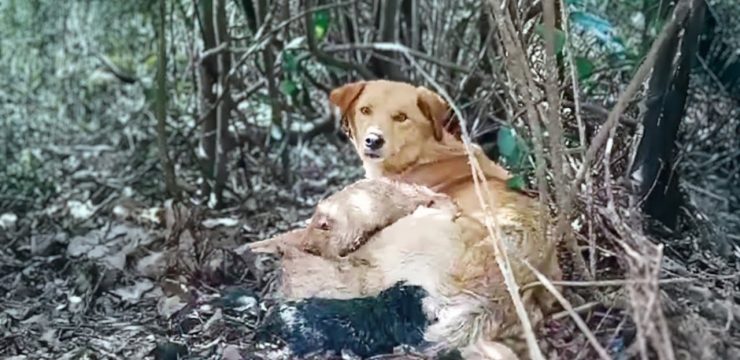
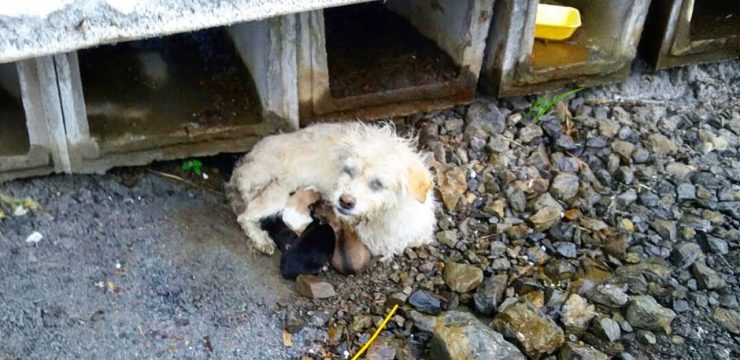
For fourteen years, a dog named Haeng-un — which means “Lucky” in Korean — knew nothing but the weight of a chain.
Chained outside a factory day after day, season after season, Lucky was put there for one purpose: to guard. He wasn’t a pet. He wasn’t a companion. He was a tool. And like an old tool no longer deemed useful, he was left outside, exposed to scorching summers and bitter winters, with barely enough care to sustain him.
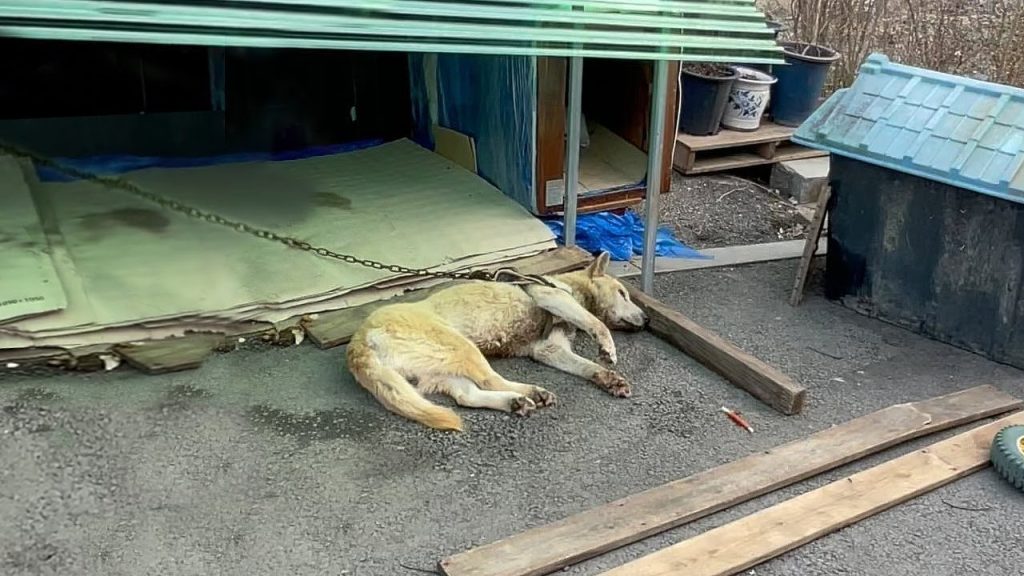
Nobody noticed when he stopped standing. Nobody paid attention when his legs gave out beneath him. And nobody came when he lost the will to go on.
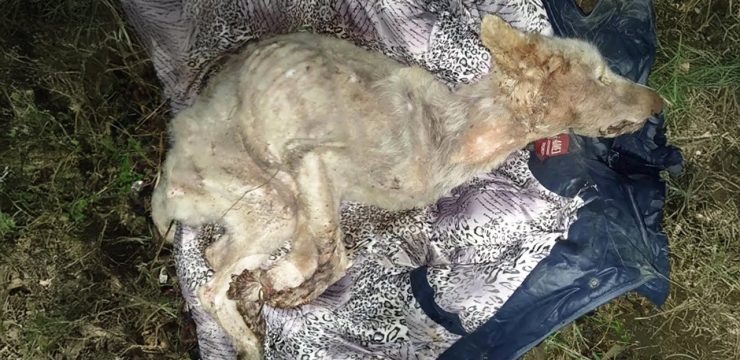
By the time a dedicated animal rescue team found him, Lucky was no longer able to rise to his feet. His breathing was labored and shallow. His eyes, once perhaps bright with the hope that someone would come for him, had grown dim. He had surrendered — not out of weakness, but out of an exhaustion so deep that even the strongest spirit cannot outrun it.
What happened next is nothing short of a miracle born from human compassion.
The rescue team didn’t hesitate. They carefully loaded Lucky into their vehicle and rushed him to a veterinary clinic, where medical staff immediately went to work assessing the damage that fourteen years of neglect had done to his aging body. The diagnosis was heartbreaking: heartworm disease, painful skin infections that had gone untreated for far too long, and severe spinal deterioration — the very condition that had stolen the use of his legs.
The road ahead would be long and uncertain. But the rescue team made a quiet, powerful decision: Lucky deserved to know what it felt like to be loved.
The days that followed were filled with IV fluids, carefully managed medications, and the kind of gentle, patient care that most of us take for granted. Volunteers and veterinary staff took turns hand-feeding him, coaxing him to eat when his body resisted. They spoke to him softly. They sat beside him. They let him know, in every way an animal can understand, that he was no longer alone.
And slowly — so slowly it seemed almost impossible — Lucky began to respond.
There’s something remarkable that happens when a living creature, human or animal, is shown genuine, unconditional love after a long period of suffering. It’s as if something deep inside them remembers what they were before the hardship. A flicker returns to the eyes. The breathing steadies. The spirit, buried but never fully extinguished, begins to rise again.
That’s exactly what happened with Lucky.
His appetite returned. His infections began to heal. The heartworm treatment, while grueling, started to take effect. And the veterinary team, encouraged by his progress, introduced a specialized wheelchair harness — a device designed to support dogs who have lost the use of their hind legs, giving them the mechanical assistance their damaged spines could no longer provide.
What came next left everyone in that room speechless.
With the harness carefully fitted around his frail but determined body, Lucky began to move. One small, hesitant step. Then another. His rescuers — the same people who had sat with him through his darkest nights, who had whispered encouragement when he couldn’t eat, who had refused to give up on him even when the odds felt overwhelming — erupted in cheers.
He was walking.
After fourteen years of chains and confinement, after months of paralysis and pain, this senior dog — this old, forgotten guardian — was walking.
It’s difficult to put into words what a moment like that means. For those of us who have ever loved a dog, who have looked into the eyes of an animal and felt that wordless, sacred connection, watching Lucky take those first steps feels like witnessing something holy. It is a reminder that resilience doesn’t belong only to the young or the strong. It lives in the old ones too — in the ones who have endured the most, who have been overlooked the longest, and who still, somehow, find the courage to keep going when someone finally shows up to stand beside them.
Lucky’s story is not just about one dog. It is about what becomes possible when people choose empathy over indifference, action over apathy. It is about the rescue workers and volunteers who show up every single day — not for recognition, not for reward — but because they believe, with quiet certainty, that every life matters.
Senior dogs like Lucky are adopted far less frequently than puppies. They are often overlooked at shelters, passed over for younger, more energetic animals. And yet, in many ways, they have the most to offer: a calm presence, a depth of gratitude, a loyalty that has been refined by years of living.
If Lucky’s journey moves you, consider opening your heart — and perhaps your home — to a senior dog in need. Visit your local animal shelter. Volunteer. Donate to rescue organizations doing this vital work. Share stories like Lucky’s so that others might be inspired to act.
Because somewhere out there, right now, there is another Lucky waiting. Waiting for someone to notice. Waiting for someone to care. Waiting for the moment when a kind pair of hands finally reaches down and says: You are not forgotten. You are worth saving. And it’s not too late.