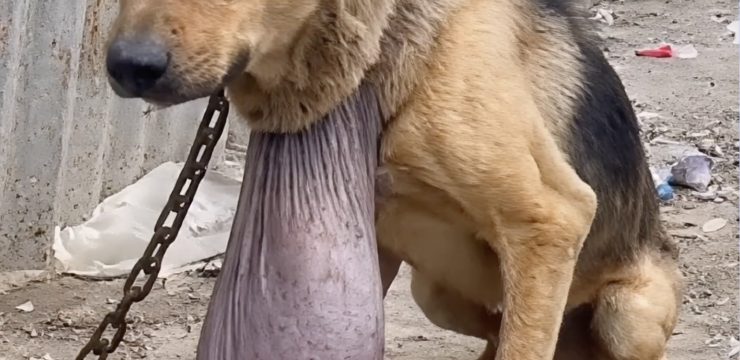
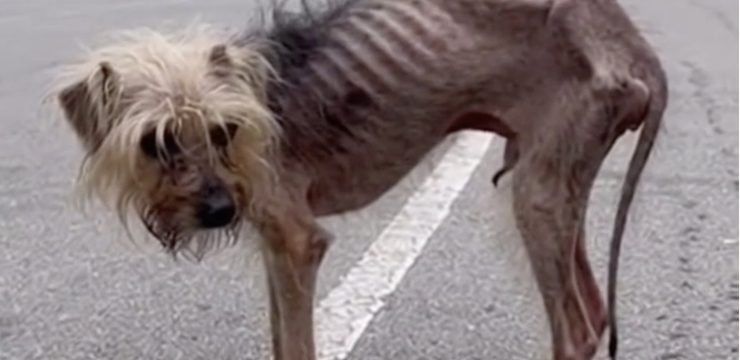
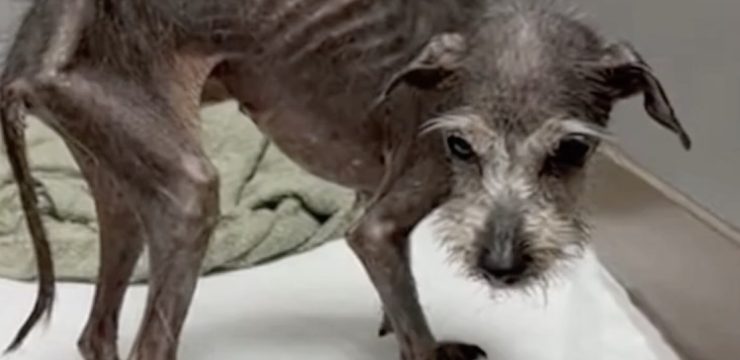
When the rescue team first received the urgent call about a stray dog in desperate need, they didn’t expect the situation to be this heartbreaking. The dog, later named Bunica, was found wandering aimlessly with a massive growth on her back. Her steps were slow, almost painful to watch. She looked frightened and confused, as if every part of her body ached.
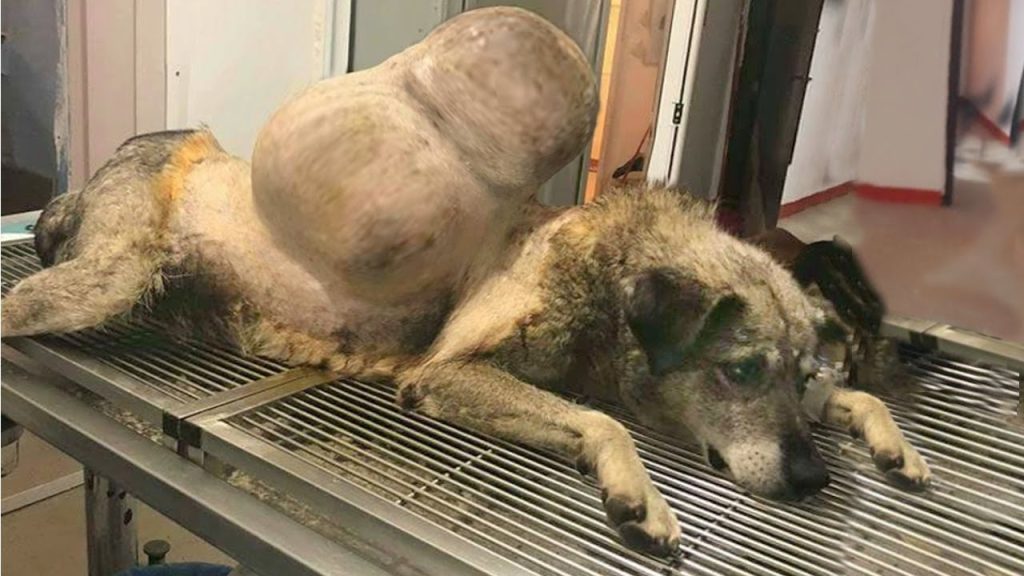
She had clearly been abandoned. Her eyes held the weight of betrayal, and her entire demeanor showed how deeply she feared humans. She flinched at every sound, every movement. But beneath the fear, the rescuers saw something else—hope. Faint, but still there.
Approaching her wasn’t easy. The team tried to speak softly and offer her bits of food, crouching low to seem less intimidating. Hours passed, and progress came slowly. Bunica was starving, but trust was something she couldn’t afford to give easily. It had clearly been broken before.
Eventually, they knew they had to make a difficult choice. For her safety—and theirs—they used a mild tranquilizer to gently help her into a transport crate. It was the safest way to ensure she wouldn’t hurt herself or run off in fear. Once secured, they rushed her to the nearest veterinary clinic.
What the vet team saw left them in stunned silence.
The dark, swollen tumor stretched across Bunica’s back like a burden she had carried for far too long. It was massive, nearly the size of a watermelon, tight against her skin, visibly pulling her posture into a painful curve. The size and weight of it explained her limp, her exhaustion, her inability to move freely. The veterinarian tried to assess it, but even with both hands, it was difficult to grasp the full mass.
She was immediately stabilized. The tumor had likely been growing for months, and Bunica’s body had done its best to keep going despite the pain. The staff administered fluids, ran bloodwork, and performed initial imaging. Thankfully, there were no signs the tumor had spread to her internal organs. Still, surgery would be risky.
They scheduled the operation three days later, using the time to prepare her body for the stress of surgery. She was fed, cleaned, and held gently by volunteers who whispered reassurances. She didn’t wag her tail, not yet—but her eyes followed those who cared for her, trying to make sense of this new kindness.
The morning of the surgery came, and the team moved swiftly but tenderly. The operating room was silent except for the rhythmic beeping of the monitors. Every person in that room knew the risks. Removing a tumor that large, especially from an older, malnourished dog, was no small task.
But Bunica was a fighter.
The procedure lasted nearly three hours. The tumor was carefully detached from the surrounding tissue. When it was finally lifted from her body, the weight of it—physically and emotionally—was overwhelming. One vet quietly remarked that it was like watching someone remove a heavy backpack that had been worn for years.
She made it through.
Recovery wasn’t instant. The first 24 hours were critical. But slowly, signs of healing began to appear. Her breathing steadied. Her appetite returned. She began to lift her head when people entered the room. Her tail—once tucked so tightly it seemed frozen—started to relax. And one day, it wagged. Just a little. Just enough.
Ten days after her surgery, Bunica was almost unrecognizable. The physical change was striking—without the massive tumor, her frame looked lighter, more natural. But the real transformation was in her spirit. She began to greet her caretakers at the kennel door. She even allowed gentle brushing, something she would have flinched away from before.
A biopsy confirmed the best possible news: the tumor was benign. It wasn’t cancer. The growth, while enormous and debilitating, would not return. Bunica’s life wasn’t just spared—it had been renewed.
The team could barely believe the difference. She was no longer just surviving. She was living. She enjoyed sitting in the sun, resting her head on volunteer laps, and sniffing the breeze like every scent was brand new.
One of the most touching moments came when a volunteer who had been there on her first day returned. As he knelt beside her, she walked right up and rested her head against his chest. Her scar, though large and still healing, no longer seemed like a mark of pain. It had become a symbol of survival.
Bunica had carried something so heavy—physically and emotionally—for far too long. But thanks to the compassion of strangers, she was free. Free from pain. Free from fear. Free to live a life she had nearly lost.
This story isn’t just about medical care or physical recovery. It’s about resilience. It’s about the power of kindness, even when offered in small, quiet ways. It’s about the hope that can live inside even the most broken hearts.
Today, Bunica continues to heal in a loving foster home, surrounded by warmth, gentle voices, and soft beds. She still bears the scar across her back, but it’s no longer a reminder of what she lost. It’s a reminder of what she survived.
She was once discarded, forgotten, and forced to carry a weight she didn’t deserve. But now, thanks to those who refused to give up on her, she has a second chance. A chance to be loved. A chance to simply be a dog again.
And that, more than anything, is what she deserved all along.