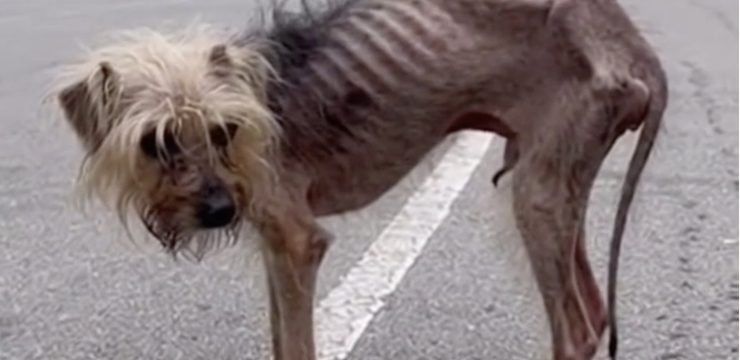
A single photograph found its way to me one quiet afternoon — a silent cry for help from a creature who could no longer speak for himself. In that picture stood a dog beneath a merciless sun, his body bound to a tall wooden post by a length of wire that bit deeply into his neck. His front paws barely touched the scorched ground, and his thin frame trembled under the weight of exhaustion. His eyes, hollow yet pleading, held a story of suffering that words could never capture. I could almost feel the heat of the earth beneath him and the ache of his body fighting to remain upright.
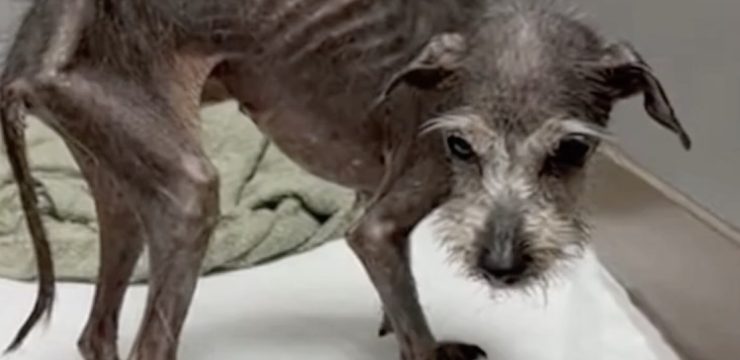
When I arrived, I found him exactly as in the picture — fragile, trembling, and fading. The cruel wire had cut so deeply that it left marks carved into his fur, and his ribs showed like silent witnesses of hunger. When the restraint was finally removed, he did not run or bark. Instead, he collapsed softly to the ground, like an ancient tree falling after too many seasons without rain. His breath came in short, uneven bursts. His tongue, parched and cracked, hung weakly from his mouth. No one knew how many days or nights had passed since he had last felt kindness, since he had last known the comfort of a gentle touch or the relief of cool water.
Without hesitation, I gathered him in my arms. My heart led me toward the healer’s lodge — the place where hope is given another chance. He was too weak to resist, too tired to fear. When the bowl of water was placed before him, he drank with desperate gratitude, gulp after gulp, as though he had never known the taste of life before that moment. Watching him drink, tears filled my eyes. I could not stop them, for every swallow he took was a small victory over the darkness that had nearly claimed him.
Then, as the water soothed his thirst, his body began to tremble once more. The healer, a gentle woman with eyes that carried wisdom and compassion, knelt beside him. She examined him carefully, her hands soft but steady, tracing each rib, each scar, each reminder of his silent battle. She looked up and said softly that his spirit was still alive — fragile, but not lost. “He will walk again,” she promised, “but not without your hand to guide him.” Her words filled the air with hope, fragile yet powerful.
He looked at me then — really looked — with eyes that carried both gratitude and fear. It was as though he knew that from this moment on, his life depended not just on medicine, but on love. That night, as he rested for the first time in who knows how long, I stayed beside him. His breathing was shallow, his dreams restless, but even in sleep, he sought closeness. I could feel the weight of his trust, and I promised silently that he would never face the cold world alone again.
The days that followed were filled with quiet miracles. At first, he could barely lift his head. His legs, stiff from pain and disuse, trembled with every attempt to stand. But each day brought progress — small, fragile steps that soon became real movement. I would cheer him on softly, whispering encouragements as his tail began to wag for the first time. It was hesitant at first, a little unsure, but it was the most beautiful sight I had ever seen. His spirit, once nearly extinguished, flickered back to life.
Weeks passed, and the bond between us deepened. I watched him rediscover the world — the grass beneath his paws, the gentle rustle of the wind through the trees, the scent of rain after a long dry spell. He sniffed every corner as if each blade of grass held a story he had forgotten. Sometimes, he would pause and look back at me, as though asking, “Is this really my life now?” And I would smile, nod, and let him lead the way. The world was new to him, and every discovery was a quiet celebration.
He began to eat well, to sleep peacefully, and to play. The stiffness in his body gave way to grace. He chased butterflies, rolled in the soft earth, and sometimes even barked at his own shadow, as if testing the sound of his own voice again. Watching him live freely was a joy beyond measure. It felt as though time itself had granted him a second chance, and I was simply the keeper of that gift.
Finally, the day came when the healer declared him strong enough to leave. It was a morning bright with promise, the kind of day when the light feels like a blessing. He greeted every person at the lodge with gentle eyes and a wagging tail, as though offering his thanks to each soul who had helped him heal. When he saw me waiting by the car, his entire body moved with joy. He jumped in eagerly, as if he already knew this was the beginning of his new chapter.
Today, he lives with me — not as a rescued soul, but as family. His coat shines, his eyes sparkle, and his heart is at peace. Sometimes, when he curls up beside me, I can still feel the faint scars under his fur, but they no longer tell a story of pain. They tell a story of survival, of trust restored, of love found in a world that had once forgotten him.
When we walk together in the evening light, his steps are strong, confident, and full of life. The past lingers only as a whisper, a distant echo that reminds us both how far he has come. What remains now are smiles, joy, and the quiet companionship of two spirits bound by compassion. I often think back to that first photograph — the one that started it all — and I realize how something as simple as a picture can change a life forever. Because in saving him, I found something too: a deeper understanding of kindness, of grace, and of the healing power of love that expects nothing in return.