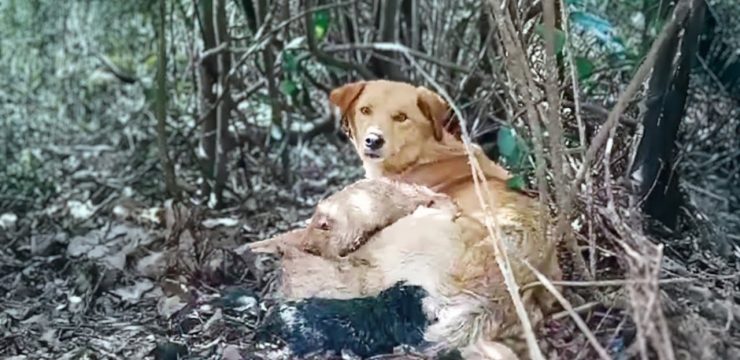
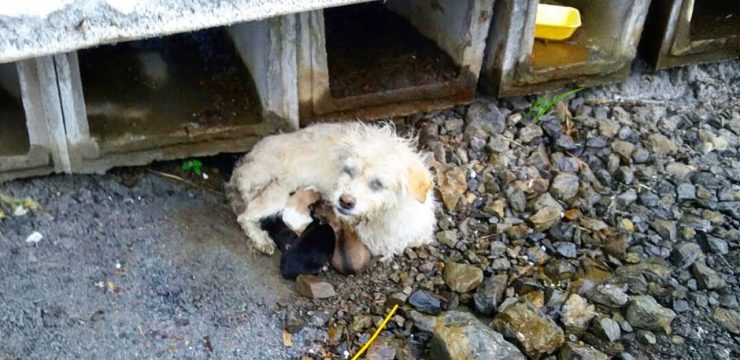
Nobody saw it happen. There were no witnesses, no cameras catching the moment — just an old dog named Nazar, lying in the mud outside the gate that had once been his home, shivering and utterly confused about why the world had suddenly turned its back on him.
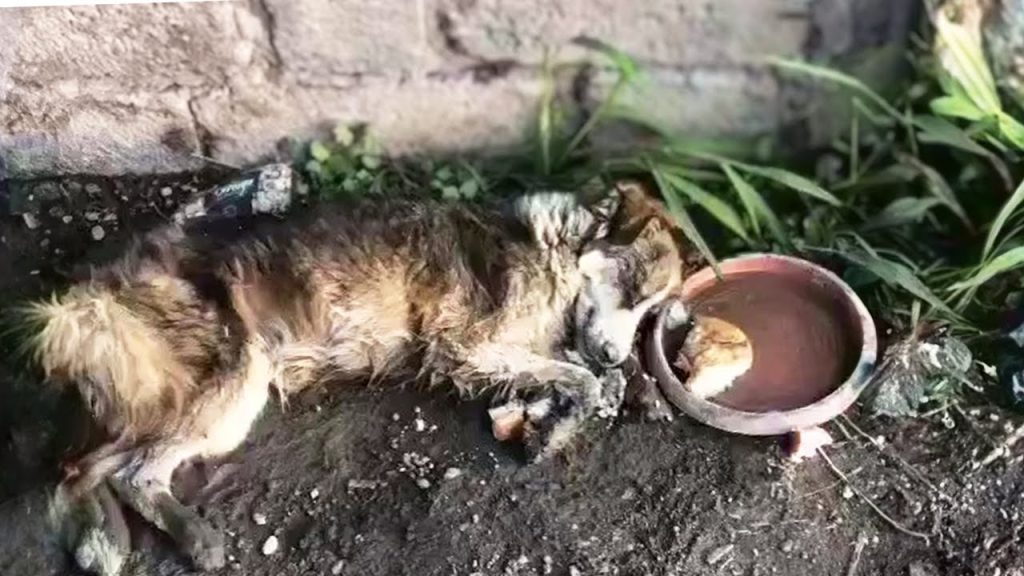
His owner had dragged him out and left him there with nothing but a small piece of bread. That was it. That was all his years of loyalty were worth to the person he had trusted most.
Nazar didn’t run away. He didn’t give up on the person who had abandoned him. Instead, he pressed himself against that gate and waited, desperate to be let back inside, begging in the only way a dog knows how — with patient, heartbreaking hope. A kind neighbor noticed him there, growing weaker by the hour, and made the call that would change everything.
When the rescue team arrived, nothing could have fully prepared them for what they found.
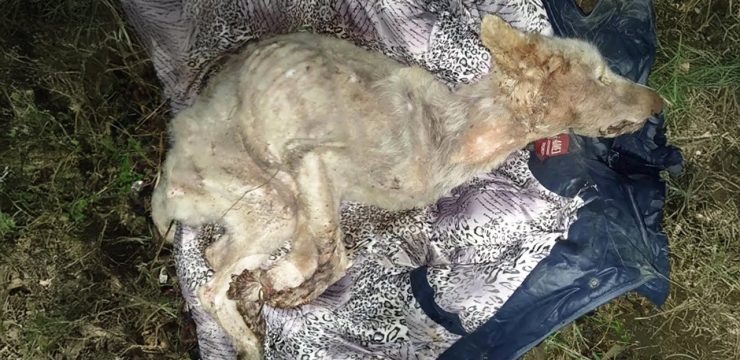
Nazar was covered from head to tail in mud, his coat overtaken by ticks and the raw, painful damage of severe mange that had gone untreated for far too long. He was thin in the way that speaks of prolonged hunger, not just a missed meal or two. His eyes were dull, his body trembling. But the most alarming thing — the detail that stopped every person on that team cold — was that Nazar could not stand up. Not even close. His legs simply would not hold him.
Veterinarians ran a full panel of tests, and the results were deeply troubling. Nazar tested positive for Leishmaniasis, a serious parasitic disease. His blood counts were dangerously poor. His overall condition pointed to a dog who had been neglected for an extended period of time, not days or weeks, but far longer.
X-rays were taken, searching for fractures or injuries that might explain why he couldn’t use his legs. The bones came back clean. No breaks. No obvious structural damage. So what had robbed this dog of his ability to walk?
The answer, when it finally came, was more heartbreaking than anyone had imagined.
As the team learned more about Nazar’s life before rescue, a devastating picture emerged. For the majority of his life, Nazar had been confined inside a small cage — a space that might have fit a puppy, but had never been upgraded as he grew. Year after year, he had lived cramped and immobile in that enclosure. His muscles, deprived of the movement every living creature needs to survive, had simply wasted away. The medical term is muscle atrophy. The human term is cruelty.
His legs had forgotten how to work because he had never truly been allowed to use them.
In the hands of the rescue team and their veterinary partners, Nazar’s recovery began — slowly, painfully, and with more determination than most of us will ever witness in our lifetimes.
The team designed a careful rehabilitation plan tailored specifically for his condition. It included acupuncture sessions to help stimulate nerve response in his weakened limbs, along with daily muscle massages intended to restore circulation and begin rebuilding what years of confinement had taken away. Every session required patience — from the team and from Nazar himself.
And Nazar showed up every single time.
He fell, often. His legs would buckle beneath him mid-effort, and he would sink back down to the ground. But he never stopped trying. There was something in this dog — some quiet, stubborn spark of life — that refused to accept the idea that he was finished. His trainers watched in quiet awe as he pushed himself again and again, his body trembling with effort, his eyes never losing that soft flicker of willingness.
Two weeks into his rehabilitation, something shifted.
His back legs, which had for so long been nothing more than dead weight beneath him, began to respond. First just a tremor of movement. Then a tentative push against the floor. And then — slowly, unsteadily, the way a toddler takes those first wobbling steps across a living room — Nazar stood.
And then Nazar walked.
The people in that room who witnessed it were not composed. How could they be? This was a dog who had spent years locked in a cage too small for his body, discarded by his owner like something broken and useless, left shivering in the mud with a piece of bread as his severance. And here he was, moving forward on his own four legs, carrying himself with a quiet dignity that none of his suffering had managed to destroy.
There is a kind of resilience that lives in animals — particularly in dogs — that defies easy explanation. They do not carry bitterness the way humans do. They do not spend their energy on resentment or self-pity. When given even the smallest reason to hope, they hope completely.
Nazar had every reason to give up. He chose, instead, to walk.
For anyone who has ever loved a dog, or who has ever felt discarded by a world that didn’t see their worth, Nazar’s story carries something important: the reminder that it is never too late to begin again, and that the body and spirit are capable of healing in ways that can still take your breath away.
He stepped out of that dark chapter and into a new life — one where every step forward is its own small miracle.